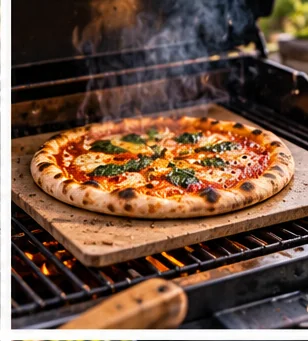
Products and configurations to compare
Pizza steel or stone
Choose by the grill's heat balance.
Best when: you want repeatable crust
Watch for: must fit with airflow clearance
Wood + metal peel set
Wood for launching, metal for turning/retrieval.
Best when: you make several pizzas
Watch for: large peels need storage space
High-temp infrared thermometer
Excellent for pizza and griddles.
Best when: you want repeatable launch temperature
Watch for: surface only
Preheat is a recipe variable
The same dough behaves differently on a half-heated surface.
Launch technique deserves practice
Build quickly and shake the peel before approaching the grill.
Rotate toward the hot side
Most backyard grills have uneven zones.
Close the lid between turns
Top heat matters.
Keep flour under control
Excess bench flour burns and turns bitter on very hot surfaces.
Pizza on a grill is a balance between bottom heat and top heat
Steel transfers heat into dough faster than stone, which is excellent when the cooking surface needs more energy. Stone transfers heat more gently and can be easier to manage on grills that already run extremely hot underneath. Neither wins universally because the lid, burner or charcoal arrangement determines how quickly the rim and toppings cook relative to the bottom crust.
Preheating the surface fully matters more than the air-temperature gauge. A stone or steel can lag far behind the grill dome during startup. An infrared thermometer can make surface temperature repeatable, while a proper peel prevents dough from becoming an emergency before it reaches the surface.
Measure before buying
A 16-by-14-inch steel can be perfect in an oven and awkward in a compact grill if it blocks airflow. Round stones also need clearance. Buy by actual grill dimensions and safe operating guidance, not by the largest surface that can physically squeeze under the lid.
Before checkout
- Accessory physically fits the exact grill or cooking surface
- Heat rating exceeds the intended grill or sear temperature
- Thermometer type matches instant-read or leave-in use
- Fuel and storage gear protects against moisture
- Food-contact materials are appropriate and cleanable
- Grease and airflow paths remain unobstructed
- Handles and controls remain usable with grill gloves
- Outdoor storage can tolerate weather or comes inside
- Replacement probes, heads or parts remain available
- The purchase solves a repeated problem or adds a real cooking method
The accessory should earn its storage space
Outdoor cooking equipment multiplies quickly because each item looks inexpensive by itself. Picture where the product lives after the cook, when it is greasy, cold and wet. A rotisserie kit has a spit, motor and brackets. A cast-iron plate may weigh more than ten pounds. A thermometer is tiny and used constantly. Frequency of use should influence the budget as strongly as feature count.
Price the ownership layer too. Wireless probes need charging or replacement, steam-cleaning heads wear, pellet bins multiply by flavor and model-specific covers eventually weather. A good purchase still makes economic sense three seasons later.
First-cook test
Use new gear on a simple cook before a party. Verify thermometer connectivity, dry-fit rotisserie clearance, make sure grease can drain around a griddle, learn the pizza surface at your grill's actual temperature and confirm cleaning tools match the grate spacing. A ten-minute test can prevent a ruined meal or damaged accessory.
Afterward, decide whether the item changed capability, consistency or cleanup enough to keep. If it did not, use the return window rather than permanently adding it to the patio pile.
Frequently asked questions
Do I need IR?
No, but it improves repeatability.
Wood or metal peel?
Wood launches well; metal turns well.
How long preheat?
Until the surface itself reaches target temperature.
Can parchment go on the grill?
Only within its specified heat limit.
Current product/source checks
Affiliate disclosure: GrillGuide.co may earn from qualifying purchases through Amazon Associates and eBay Partner Network at no extra cost to you. Amazon links use scouttheory-20; eBay links use campaign 5339137014.