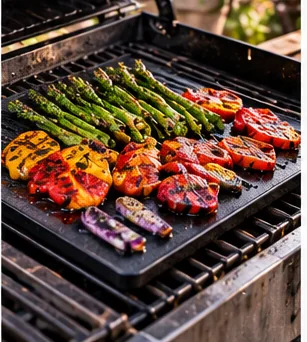
Products and configurations to compare
Lodge Pro-Grid
Grill/stove/campfire compatible.
Best when: you want removable versatility
Watch for: heavy and no grill-specific grease drain
Full-size model-specific griddle
Designed grease path.
Best when: flat-top cooking is frequent
Watch for: exact model compatibility
Thick stainless/carbon-steel plate
Check thickness and drainage.
Best when: you dislike cast-iron seasoning
Watch for: thin plates can warp
Do not block the firebox
Airflow and burner behavior matter.
Cast iron stores heat
Great for crust but slow to change temperature.
Steel responds faster
Thickness determines stability.
Grease management is safety
Burger fat can overwhelm an improvised plate.
Check lid clearance
Handles and tall side walls can interfere.
The best accessory unlocks a cooking method
A griddle changes contact cooking, a rotisserie changes heat exposure, a basket contains small food, and a smoker tube adds an independent smoldering source. Those are meaningful capabilities. Many other accessories simply duplicate tools already in the kitchen. If a product does not make a recurring cook easier or possible, it should not earn permanent storage space.
Fitment is the hidden cost. Rotisserie spits depend on grill width and brackets. Griddle plates need grease clearance. Baskets need lid room. Covers need exact dimensions. Measure the grill and think through hot-state handling before buying.
Material changes maintenance
Cast iron stores heat and rewards seasoning but needs drying and oil. Stainless is easier around water and high heat. Coated accessories can be easy-release but must stay under their coating's temperature limits. Choose a material whose care routine you will actually follow.
Before checkout
- Accessory physically fits the exact grill or cooking surface
- Heat rating exceeds the intended grill or sear temperature
- Thermometer type matches instant-read or leave-in use
- Fuel and storage gear protects against moisture
- Food-contact materials are appropriate and cleanable
- Grease and airflow paths remain unobstructed
- Handles and controls remain usable with grill gloves
- Outdoor storage can tolerate weather or comes inside
- Replacement probes, heads or parts remain available
- The purchase solves a repeated problem or adds a real cooking method
The accessory should earn its storage space
Outdoor cooking equipment multiplies quickly because each item looks inexpensive by itself. Picture where the product lives after the cook, when it is greasy, cold and wet. A rotisserie kit has a spit, motor and brackets. A cast-iron plate may weigh more than ten pounds. A thermometer is tiny and used constantly. Frequency of use should influence the budget as strongly as feature count.
Price the ownership layer too. Wireless probes need charging or replacement, steam-cleaning heads wear, pellet bins multiply by flavor and model-specific covers eventually weather. A good purchase still makes economic sense three seasons later.
First-cook test
Use new gear on a simple cook before a party. Verify thermometer connectivity, dry-fit rotisserie clearance, make sure grease can drain around a griddle, learn the pizza surface at your grill's actual temperature and confirm cleaning tools match the grate spacing. A ten-minute test can prevent a ruined meal or damaged accessory.
Afterward, decide whether the item changed capability, consistency or cleanup enough to keep. If it did not, use the return window rather than permanently adding it to the patio pile.
Frequently asked questions
Can Lodge go on a gas grill?
Lodge lists it as grill compatible.
Cast iron or steel?
Depends on heat retention and maintenance.
Remove grill grates?
Only when the accessory/grill instructions call for it.
Breakfast?
Yes, griddles excel at it.
Current product/source checks
Affiliate disclosure: GrillGuide.co may earn from qualifying purchases through Amazon Associates and eBay Partner Network at no extra cost to you. Amazon links use scouttheory-20; eBay links use campaign 5339137014.